Alignments are one of those things that generate lots of discussion, in part because they've changed meaning over the years. By the time you get to 3rd edition, "Lawful Good" had officially changed meaning to "Obedient Stupid," which made it possibly the most unpopular alignment for player characters. However, it was more intelligible in the early editions of the games, since they were moral axes, not strict, behavioral rules.
The Law/Chaos axis:
Lawful: The needs of society outweigh the needs of the individual. Order is preferable to chaos. Rulers, authorities, and hierarchies exist for a good reason and are necessary to maintain society.
Chaotic: Order, hierarchy, and social convention are restrictive or even harmful. Civilization is a prison. Aristocrats are obnoxious, and disciplined armies are a self-contradictory absurdity to you.
The Good/Evil axis:
Good: Every human and demihuman (i.e. player races) has the right to life, liberty, and the pursuit of happiness.
Evil: The weak exist to serve the strong. Might makes right. Selfishness is good; charity is for fools.
What about Neutrality? Often, D&D players take "neutral" to mean "amoral," but more often than not, "neutral" played this way is actually "evil." A character who drifts around the world, doing whatever will personally benefit him the most, with little regard for anything but his own profit and increasing power, is chaotic evil, not neutral!
That's right, murder-hobos. You're chaotic evil.
Neutrality in the Greyhawk context means that you believe moral forces must be held in balance for the true good of the world. Civilization has its place, as does wild nature. The hopes and dreams of human beings are held in check by other forces which cull the weak and put limits on ambition.
A classic druid is True Neutral. They are not the enemies of civilization, but neither can they be relied on to help the armies of Gran March go wipe out orcs once and for all. In fact, should the forces of civilization log too many forests, dam up too many rivers, and plow too many plains, a True Neutral druid just might stand back while a tribe of hill giants raids the king's realm, so that nature might reclaim the land and bring balance to the world.
Furthermore, no alignment means "stupid." Just because a Paladin is lawful good doesn't mean he's going to draw his sword and charge into a group of Fire Giants guarding a chasm. A Chaotic Neutral thief is, in fact, able to restrain himself from robbing the king and incurring his wrath. If players are using alignments as an excuse to do insane, self-destructive things, they really are doing it wrong.
Friday, August 24, 2018

Thursday, August 2, 2018
Random Snapshot of TTRPG Amazon Ranks
Here are the Amazon ranks in fantasy gaming. D&D 5e is the hobby's juggernaut, but let's see how it's going (omitted non-TTRPG books):
I think what's likely is we'll see initial numbers out of the gate that put Pathfinder 2 in the top ten in Amazon Fantasy Gaming. It may even crack the top 100 in all books; after all, Starfinder launched at #184. But it will rapidly fall off from there as its audience will be limited largely to the Paizo faithful and their immediate friends.
Is anyone even talking about Starfinder now?
- D&D Player's Handbook
- D&D Dungeon Master's Guide
- D&D Monster Manual
- ---
- D&D Xanathar's Guide to Everything
- D&D Mordenkainan's Tome of Foes
- D&D Volo's Guide to Monsters
- D&D Dungeon Master's Screen Reincarnated
- ---
- D&D Starter Set
- ---
- Pathfinder Playtest Rulebook
- ---
- Sword Coast Adventurer's Guide
- ---
- ---
- D&D Guildmaster's Guide to Ravinica
- ---
- ---
- ---
- D&D Tales From the Yawning Portal.
I think what's likely is we'll see initial numbers out of the gate that put Pathfinder 2 in the top ten in Amazon Fantasy Gaming. It may even crack the top 100 in all books; after all, Starfinder launched at #184. But it will rapidly fall off from there as its audience will be limited largely to the Paizo faithful and their immediate friends.
Is anyone even talking about Starfinder now?
Sunday, July 29, 2018
Battle Master: Worst 5e Mechanics
In my opinion, 5e's Battle Master Fighter is hands down the worst design of the core classes and archetypes. It's not that it suffers from being underpowered (that award goes to the Way of Four Elements Monk), is counterintuitive (that'd be the Beast Master Ranger), or has a crippling design bug (hello, Wild Magic Sorcerer), its' that of all the classes, it suffers the most egregiously from dissociated mechanics.
For the most part, 5e's done a very good job of clawing back from 4e's dissociated design, which is why the earlier game was frequently derided as feeling like a video game. There are largely 3 kinds of resources:
1. Magical power, mostly in the form of spell slots.
2. Physical stamina, such as a barbarian's rage or a fighter's action surge.
3. Durability, mainly in the form of hit points.
The Battle Master's Combat Superiority Dice don't really fall into any category. They can't be stamina, because they can be used to heal allies or order them to attack, and they're not magical, either. They're completely dissociated from the character and his fictional world. They're not the only example, of course. There's no apparent reason bards can't inspire people more often. The expansions have even more dissociated mechanics, such as the Purple Dragon Knight's ability to share his Second Wind, or Cavalier special attacks being limited by his strength modifier.
But overall, Battle Master is the worst. The class works fine as written, but I don't particularly like having them at the table. They add a weird flavor to the game. You've got your monk channeling ki, your wizard exhausting his magical energy, your barbarian pushing himself to his physical limits, and your battle master...spending superiority dice. It's just weird, and doesn't really fit the tone of the game.
For the most part, 5e's done a very good job of clawing back from 4e's dissociated design, which is why the earlier game was frequently derided as feeling like a video game. There are largely 3 kinds of resources:
1. Magical power, mostly in the form of spell slots.
2. Physical stamina, such as a barbarian's rage or a fighter's action surge.
3. Durability, mainly in the form of hit points.
The Battle Master's Combat Superiority Dice don't really fall into any category. They can't be stamina, because they can be used to heal allies or order them to attack, and they're not magical, either. They're completely dissociated from the character and his fictional world. They're not the only example, of course. There's no apparent reason bards can't inspire people more often. The expansions have even more dissociated mechanics, such as the Purple Dragon Knight's ability to share his Second Wind, or Cavalier special attacks being limited by his strength modifier.
But overall, Battle Master is the worst. The class works fine as written, but I don't particularly like having them at the table. They add a weird flavor to the game. You've got your monk channeling ki, your wizard exhausting his magical energy, your barbarian pushing himself to his physical limits, and your battle master...spending superiority dice. It's just weird, and doesn't really fit the tone of the game.
Saturday, July 7, 2018
5e Goodness: Demon Lords
5e's "bounded accuracy," meaning that stats no longer shoot to infinity, was initially one of the most questioned parts of the system. I feel like overall it was a strong decision, as adding huge numbers to a 20-sided die roll broke any sense of intuition I had about previous WotC editions (is +23 to attack a lot?). It's not flawless, but keeping the numbers in a defined range makes design problems tractable. I recently got Out of the Abyss, and comparing this book's stats for Yeenoghu, Demon Prince of Gnolls, to his Book of Vile Darkness (3.5) version I think really shows the strengths of 5e design.
The problem with the left is I don't know what those numbers really mean. I know how high +16 to attack is. It's "the rogue is toast if this bastard gets close." This is because the absolute highest base AC goes with magic items is 29 (+3 shield, +3 plate, ring & cloak of protection, +1 Armored style). But how high is +55? Is Yeenoghu auto-hitting his attacks? Or do magic items get you over 60 AC by the time you're ready to fight toe-to-toe with Yeenoghu? I mean, I guess they must...but then this highlights the absurdity. Roll a number from 1 to 20...then add 55.
Come on.
Second thing was that to type this up at all, I had to refer to three different sources for the BoVD version. In 3.0, monsters are loaded up with tags that you have to look up. Yeenoghu has "tanari'i traits" and "outsider traits." This is in addition to his feats (most of which are really common, like Power Attack, but still, there's potentially a lot to look up). 5e has everything right there in the stat block.
Now, the 3.0 Yeenoghu obviously can't even be approached by low-level heroes. They wouldn't be able to hurt him, and he'd auto-hit them to death. Additionally, he has spells to ensure he has minions, a fear aura, and a whole bunch of other crap. All this is based on the assumption that the DM is just a fleshy computer who can't figure out on his own that the "Demon Prince of the Gnolls" ought to have, uh, gnolls with him, or that you shouldn't have sessions where a minor deity starts off with a thousand longbowmen shooting him simultaneously with enchanted arrows. There is basically a lot of stupid math to prevent silly edge cases that don't happen in real games. This is ironic for a game where the Fighter is fundamentally broken as written.
But how badass is the 5e version? Well, he isn't invincible, and the point of bounded accuracy is acknowledging that he doesn't need to be because nobody runs D&D as a simulation. Honestly, the number of people who care whether or not you can drop a monster from the book into an artificially constructed scenario like 900 9th-level monks or something and have it work out "logically" is vanishingly small. If the DM decides to send you spelunking into the lair of the gnoll prince at 10th level, you're going to get TPK'd and not really care if you did 102 damage before you all went down.
Instead of making Yeenoghu fearsome by making all his numbers super big, he hits really hard, has riders on his hits that will annihilate moderate-level parties quickly, and has a number of useful spells. With all that considered, the guy is fully capable of downing any character of 14th level or below in a single action, and even a 20th-level wizard isn't going to last a round toe-to-toe. Like his 3rd edition predecessor, he's got a few tricks up his sleeve other than "beat the crap out of you," including "everybody save vs fear, DC 17" (hey, DC 17 means something to me!) and "teleport to wherever I want if you guys are trouble."
So 5e dispenses with theorycraft nonsense in order to keep numbers sensible and monster stat blocks readable, and relies on the DM to not be a total idiot to make it all work.
Stat
|
3.0
|
5e
|
Hit Dice
|
33d8+363 (511)
|
24d12+192 (348)
|
Initiative
|
+13
|
+3
|
Speed
|
40’
|
50’
|
AC
|
42/24/33
|
22
|
Saves
|
+29/+27/+25
|
+9/+10/+15/+3/+14/+2
|
Attack
|
+51/+46/+41/+36 (+4 vs good)
|
+16 (x3 flail, x1 bite)
|
Damage
|
1d12+24
|
2d12+9 (flail) 4d10+9 (bite)
|
Resistance
|
DR 15/+6, 10 acid/cold/lightning
|
Cold, fire, lightning, spells
|
Immune
|
Fire, poison
|
Poison, mundane weapons
|
The problem with the left is I don't know what those numbers really mean. I know how high +16 to attack is. It's "the rogue is toast if this bastard gets close." This is because the absolute highest base AC goes with magic items is 29 (+3 shield, +3 plate, ring & cloak of protection, +1 Armored style). But how high is +55? Is Yeenoghu auto-hitting his attacks? Or do magic items get you over 60 AC by the time you're ready to fight toe-to-toe with Yeenoghu? I mean, I guess they must...but then this highlights the absurdity. Roll a number from 1 to 20...then add 55.
Come on.
Second thing was that to type this up at all, I had to refer to three different sources for the BoVD version. In 3.0, monsters are loaded up with tags that you have to look up. Yeenoghu has "tanari'i traits" and "outsider traits." This is in addition to his feats (most of which are really common, like Power Attack, but still, there's potentially a lot to look up). 5e has everything right there in the stat block.
Now, the 3.0 Yeenoghu obviously can't even be approached by low-level heroes. They wouldn't be able to hurt him, and he'd auto-hit them to death. Additionally, he has spells to ensure he has minions, a fear aura, and a whole bunch of other crap. All this is based on the assumption that the DM is just a fleshy computer who can't figure out on his own that the "Demon Prince of the Gnolls" ought to have, uh, gnolls with him, or that you shouldn't have sessions where a minor deity starts off with a thousand longbowmen shooting him simultaneously with enchanted arrows. There is basically a lot of stupid math to prevent silly edge cases that don't happen in real games. This is ironic for a game where the Fighter is fundamentally broken as written.
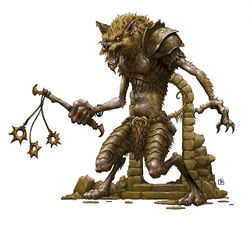 |
| 3.0 is tougher than he looks. |
But how badass is the 5e version? Well, he isn't invincible, and the point of bounded accuracy is acknowledging that he doesn't need to be because nobody runs D&D as a simulation. Honestly, the number of people who care whether or not you can drop a monster from the book into an artificially constructed scenario like 900 9th-level monks or something and have it work out "logically" is vanishingly small. If the DM decides to send you spelunking into the lair of the gnoll prince at 10th level, you're going to get TPK'd and not really care if you did 102 damage before you all went down.
Instead of making Yeenoghu fearsome by making all his numbers super big, he hits really hard, has riders on his hits that will annihilate moderate-level parties quickly, and has a number of useful spells. With all that considered, the guy is fully capable of downing any character of 14th level or below in a single action, and even a 20th-level wizard isn't going to last a round toe-to-toe. Like his 3rd edition predecessor, he's got a few tricks up his sleeve other than "beat the crap out of you," including "everybody save vs fear, DC 17" (hey, DC 17 means something to me!) and "teleport to wherever I want if you guys are trouble."
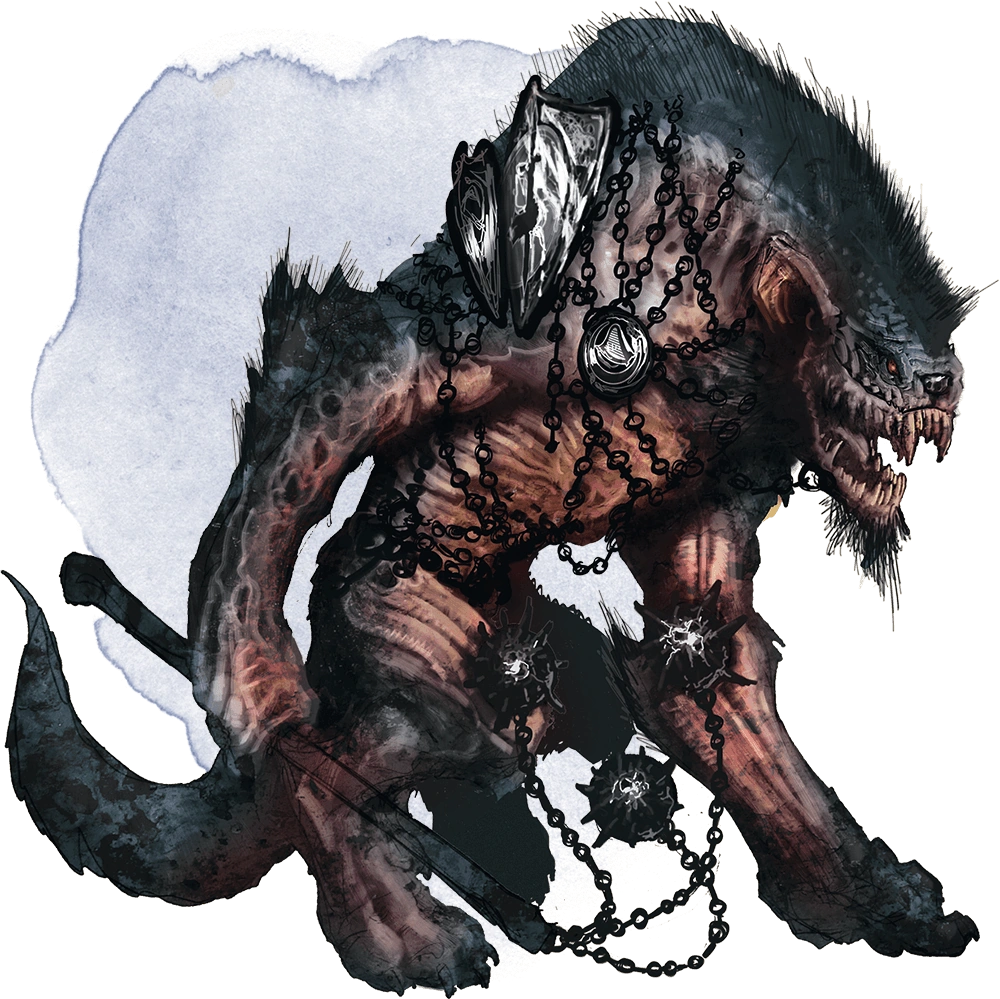 |
| 5e art took a step up. |
So 5e dispenses with theorycraft nonsense in order to keep numbers sensible and monster stat blocks readable, and relies on the DM to not be a total idiot to make it all work.
Thursday, July 5, 2018
The 5e Skinner Box
I've been experimenting with running AD&D adventures using the 5e rule set, but with the older XP tables. Just having a slower leveling pace so changes the nature of the game that it's kind of shocking to go back to the old, I mean new, way.
5e is something of a Skinner box. It's not as aggressive as a video game, but if you're playing by the book, players expect to level up every 2 to 3 sessions. As a result, they're always thinking about the next feat they're going to grab or spell they're going to learn. Many players, when they draw up a level 1 character, are already thinking about what they're going to have at level 10 or even level 20!
This is fine enough for the "storybook campaigns" WotC is selling now, where a year of gaming is supposed to take you from level 1 to 15 or so, but it has a number of unfortunate consequences.
A direct effect of this is that the low-level game just doesn't last long. Goblins and orcs aren't problems the PCs ever have to think about for too long, because after they've cleared a single tower of goblins and cleared one abandoned mine of orcs, they've leveled up so far that they're barely even interesting threats anymore. Consequently, you really can't do too much with the classic "horde" monsters before it's time to move on and start fighting giants.
A second effect is that you often don't spend enough time at lower levels to really do much with your spells and abilities. I played a Bard in a campaign once, and despite having a fairly small spell list, there were a few spells I never used, and quite a few more that only got used once or twice. This wasn't because they were bad spells so much as spells like Animate Objects and Leomund's Tiny Hut get used almost every session, while a good use for Suggestion may come up once or twice before getting much more interesting spells.
Anyway, I've found that spending more time at lower levels results in the base of the character sheet getting a lot of exercises, and enough time getting spent with orcs, hobgoblins, and bugbears for the players to really get to know them. We may never see level 15, but the old way has its merits.
5e is something of a Skinner box. It's not as aggressive as a video game, but if you're playing by the book, players expect to level up every 2 to 3 sessions. As a result, they're always thinking about the next feat they're going to grab or spell they're going to learn. Many players, when they draw up a level 1 character, are already thinking about what they're going to have at level 10 or even level 20!
This is fine enough for the "storybook campaigns" WotC is selling now, where a year of gaming is supposed to take you from level 1 to 15 or so, but it has a number of unfortunate consequences.
A direct effect of this is that the low-level game just doesn't last long. Goblins and orcs aren't problems the PCs ever have to think about for too long, because after they've cleared a single tower of goblins and cleared one abandoned mine of orcs, they've leveled up so far that they're barely even interesting threats anymore. Consequently, you really can't do too much with the classic "horde" monsters before it's time to move on and start fighting giants.
A second effect is that you often don't spend enough time at lower levels to really do much with your spells and abilities. I played a Bard in a campaign once, and despite having a fairly small spell list, there were a few spells I never used, and quite a few more that only got used once or twice. This wasn't because they were bad spells so much as spells like Animate Objects and Leomund's Tiny Hut get used almost every session, while a good use for Suggestion may come up once or twice before getting much more interesting spells.
Anyway, I've found that spending more time at lower levels results in the base of the character sheet getting a lot of exercises, and enough time getting spent with orcs, hobgoblins, and bugbears for the players to really get to know them. We may never see level 15, but the old way has its merits.
Friday, June 1, 2018
Down with optimization!
Something I have found frustrating about running 5e games is that so many players still approach with the 4e/3.x mindset of it being absolutely imperative to maximize your "main" stat and dump your "off" stats. This often results in new players getting harangued out of doing something they want to do, like be a halfling wizard, or be a Cleric/Sorcerer hybrid who uses metamagic to boost spells like Healing Word and Spiritual Weapon, but can also cast Scorching Ray and Magic Missile.
The reason for this mentality is that in the last two editions, if you didn't relentless chase the max modifier with every option you had, you would quickly find yourself at a massive penalty. For example, in 4e, you should start with no less than a +4 bonus to attack from your main stat, and by the end of the game level, you should have a +8 from your ability score (possibly +9) and +3 from a feat, (this is in addition to the built in bonus), so the optional part of your attack bonus should be +11. If you choose not to do that, perhaps spread your ability scores around and take more "flavorful" feats, compared to where you should be, you'll be operating at a -5 penalty or worse! And since this is across the board, someone who tries to be pretty good at several things is just useless at everything.
In 5e, the situation is much different due to the much-maligned Bounded Accuracy. Of course you don't want to be a rogue with 8 DEX, but the important thing to understand in 5e is that the die rolls just don't get very large numbers added to them. The only bit you can really fiddle with takes you from a minimum -1 to a maximum +5. It's not a trivial spread, but the reality is that if you have an 18 STR at level 17 because you decided to boost your Dexterity so you could sneak, you won't have any trouble hitting things with your magical +2 battleaxe.
For example, you could be a high level Champion with 18 STR, 18 DEX, 16 CON, the Medium Armor Master feat, 14 WIS, proficiency in stealth and perception...and you'll be quite good as a scout. You'll spy all but the stealthiest monsters, remain hidden from all but those with the keenest sight, and use heavy weapons in melee and a longbow at range. You won't be quite as good at any one thing as a specialist, but you'll be good. You can do these things in 5e, and importantly, they work. Don't let people tell you that you can't.
The reason for this mentality is that in the last two editions, if you didn't relentless chase the max modifier with every option you had, you would quickly find yourself at a massive penalty. For example, in 4e, you should start with no less than a +4 bonus to attack from your main stat, and by the end of the game level, you should have a +8 from your ability score (possibly +9) and +3 from a feat, (this is in addition to the built in bonus), so the optional part of your attack bonus should be +11. If you choose not to do that, perhaps spread your ability scores around and take more "flavorful" feats, compared to where you should be, you'll be operating at a -5 penalty or worse! And since this is across the board, someone who tries to be pretty good at several things is just useless at everything.
In 5e, the situation is much different due to the much-maligned Bounded Accuracy. Of course you don't want to be a rogue with 8 DEX, but the important thing to understand in 5e is that the die rolls just don't get very large numbers added to them. The only bit you can really fiddle with takes you from a minimum -1 to a maximum +5. It's not a trivial spread, but the reality is that if you have an 18 STR at level 17 because you decided to boost your Dexterity so you could sneak, you won't have any trouble hitting things with your magical +2 battleaxe.
For example, you could be a high level Champion with 18 STR, 18 DEX, 16 CON, the Medium Armor Master feat, 14 WIS, proficiency in stealth and perception...and you'll be quite good as a scout. You'll spy all but the stealthiest monsters, remain hidden from all but those with the keenest sight, and use heavy weapons in melee and a longbow at range. You won't be quite as good at any one thing as a specialist, but you'll be good. You can do these things in 5e, and importantly, they work. Don't let people tell you that you can't.
Wednesday, May 30, 2018
Diminishing Returns 2: Shootin' Dudes in the Face
That's right, we've been shooting guys in first person since the very earliest days! First-person shooters still have more obvious increases than racing games, but what's notable is it took me a while to find an Xb1/PS4 game that I felt really showed off the hardware. If the game is mostly confined to buildings and alleys, the improvements over the 360/PS3 era are much less striking.
Atari 2600 (1977):
Okay, you're not shooting bad guys...but still...close enough!
NES (1983):
TurboGrafx-16 (1987):
Super Nintendo (1991):
Nintendo 64 (1996):
Gamecube (2001):
PS3 (2006):
Xbox One (2013):
Subscribe to:
Posts (Atom)